Why choose Dale Woodfin?
Over 25 years of marketing, management, creative and sales experience.
I will help you define and achieve your marketing objectives as a full-time or as-needed consultant and will also consider career opportunities. Often marketing agreements are laden with legal phrasing meant to support the bottom line of the marketing firm which is frequently detrimental to the client’s budget and marketing objectives. I provide marketing services and structured rates that support your unique marketing effort, usually available on an as-needed basis and without retainer. My contract is simple and meant to outline the spirit of a mutually beneficial relationship.
While there’s no guarantee of success in the marketing industry I do guarantee if you aren't seeing the success you expect there are no lengthy contract periods or expensive buyout clauses to keep you from seeking other solutions. Beware of consultants or platforms that offer simple solutions for all your marketing woes at "to good to be true" rates. If someone is promising you instant success you can be sure they are about to trade you there experience for your money – meaning they’re not in it for long-term success and it might be costly to you. A quality consultant will provide a plan for success that doesn’t push a particular marketing channel or platform as the only marketing tool you'll ever need.
Two simple reasons to hire me:
1. You lack the resources
“Do it yourself” marketing sounds great until you have to do it yourself. Unless you have no budget at all it is most always more beneficial to concentrate on your core business than to lose focus on high level marketing. Often the investment in a good consultant can save you time and perform tasks more efficiently.
2. You need better results
A good consultant will focus on the marketing metrics that deliver potential target market prospects into the marketing funnel with the intent to convert and omit nonproductive efforts. Here’s how it works.
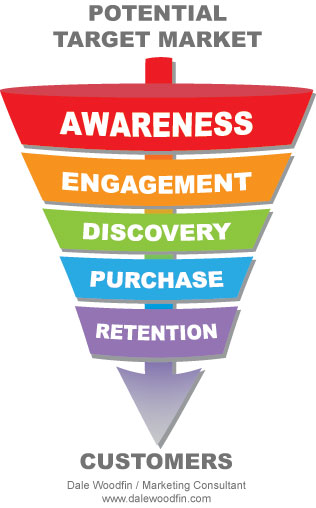
Marketing Multiplication
If you want to be a successful marketer it's time to learn some new math.
A prospective customer needs to see your marketing message through multiple marketing channels multiple times before they are able to remember your brand so, marketing math might look a little like this:
1 (message) X 1 (recipients/engagements) X 1 (marketing channels) = 0 (conversions)
1 (message) X (recipients/engagements) 100 X 2 (marketing channels) might = 0 to 6 (conversions)
1 (message) X (recipients/engagements) 250 x (marketing channels) 5 = < 30 or so, and so on - possibly.
This is odd math, right? But, this is the reality of marketing so, it becomes very important to do your research, commit to the marketing cycle and it is paramount to practice a consistent brand message and image.
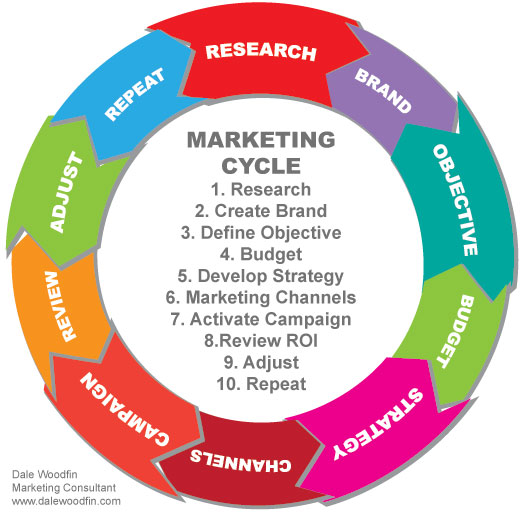
Those of you that watch a little television have become very well acquainted with the tiny animated gecko that is the successful image for the well-known insurance company, Geico. Geico uses multiple plot lines for our little green friend while keeping the brand and message consistent ensuring the potential consumer remains engaged. You can apply the same technique to your own marketing. Below is a 10 step marketing cycle to help keep you on track.
Marketing Cycle Check List
1. Conduct research to learn more about your target market
2. Create your brand image and develop a brand message
3. Define your marketing objective
4. Decide on a budget
5. Develop a marketing strategy
6. Choose the marketing channels where your potential customers frequent
7. Create and activate campaign elements to channel the prospective market into the marketing funnel over a defined period of time
8. Review your ROI and revise for greater success
9. Adjust your budget and Tweak the message variation, strategy, channels, campaign
10. Repeat and multiply (Repeat by using multiple marketing channels, multiply times)
Brand: Branding is the strategy used to build a relationship by associate between your customers and your organization. It is the visual representation of your message, the graphics and colors that make up your image. By developing a strong brand relationship over a period of time you are better able to compete with major brands. Your brand is your promise to the customer. A great place to start developing your brand is your logo and your message.
Message: Your logo and design choice grab attention but the message will move your potential customers towards your marketing objective. The well-known legend of the advertising industry David Ogilvy once said, "I do not regard advertising as an entertainment or an art form but as a medium of information. When I write an advertisement, I don't want you to tell me that you find it creative. I want you to find it so interesting that you buy the product." Make sure that your message answers a need at the level your target market will understand. Try writing your message in one paragraph then reduce it to one sentence and then three words. "Just Do It" I'm sure you got that message.
Objective: Usually the objective are based on the financial goals of the organization but can also be measured in users, leads, members, social friends and other types of achievements. For example, a nonprofit may wish to bolster awareness among the public to improve the chances of receiving a grant while increasing participation in its offering or programs.
Budget: Yes, it costs money to get your brand and message in front your potential customers in hopes of reaching your marketing objective. No one likes to think about the cost of a marketing campaign so perhaps you should consider labeling this expense as an investment. Investments are made with the intent of providing a return. This makes it a bit more palatable to allocate a part of your net profit for marketing investment. So, how much should you set aside? While there is no magic formula for success Gartner Research (2014) reported that companies spent on average 10.2% of their annual revenue on overall marketing. The important thing is to set aside enough money to access the marketing channels that will influence your market. It will be a, sometimes painful, balancing act between your marketing strategy and budget.
Strategy: The marketing strategy describes how you will achieve your marketing objective by delivering your brand message to the potential customer. Developing a strategy that fits your marketing objectives can be relatively complex in today's diverse marketing landscape. We tend to think in terms of a couple of marketing channels. However, the process really begins with an evaluation of internal and external factors which include strategic strengths and weaknesses such as technology, economics, cultural considerations, political environment and legal aspects among others. The strategy should serve the objective so back out the strategy from you.
Multichannel: Multichannel marketing is a deliberate communication or potential relationship foster interaction between you and your customers using more than one marketing channel, both direct and indirect, with the intent to influence them to achieve your marketing objective. You may choose to utilize direct channels to preemptively target the market by means of brick and mortar locations, billboards, direct mail, brochures, ads and other direct channels or indirectly by placing content on websites or social media, also known as inbound marketing that attracts potential customers into your organization, instead of going out or making outward efforts to increase customer activity. Other means of reaching customers with multichannel marketing include texting, emailing, mobile devices, websites, social media, search engine optimization (SEO), search engine marketing (SEM) or GPS to track customers' proximity to goods and services. Multichannel marketing utilizes the practices of inbound and outbound marketing with the objective of delivery your message to potential customers on the marketing channel of their choosing. In this way, the marketing cycle is more quantifiable by the marketer and conversely influenced by the potential customer.
Campaign: The campaign defines the activities and plan for measuring success. It's the plan that coordinates the strategic delivery of your brand message using selective marketing channels to realize your marketing objective within a specific budget and time. Think of the campaign as your action items. The campaign may include milestones as subordinate objectives and should be broken down by specific media placements and marketing activities with beginning and ending dates.
ROI: There no better way to plan your future marketing than to consider your return on your investment (ROI). When you've completed your campaign it's time to evaluate its success. Here's how: (Gross Profit – Marketing Investment) / Marketing Investment = ROI
When you understand your ROI position you can focus your campaign to include the most successful elements and omit those with poor returns.
Adjust and Tweak: Marketing is a never ending cycle. When evaluating the future of your marketing it is important to consider several factors such as the ROI of previous campaigns, customer responses, ongoing market research as well as your product, pricing and placement and promotion. Once you've evaluated the process make a few changes and do it again.
Multiply: Frequency is everything! 1X1=0 1X5=1 1X100=25 or so, maybe. If you want to be a successful marketer it's time to learn some new math. This probably makes a more sense than when you first read it. Marketing isn't a 1 to 1 ratio. People change behavioral patterns slowly. Remember to keep your brand identity and message consistent with creative variations. Don't give up just because it didn't go as well as you hoped and build your budget when it goes better than expected.
If this sounds like a little too much to take on as a “Do it yourself” marketer then you should contact me for some expert advice.